
When you take a generic drug, you expect it to work just like the brand-name version. But not all generics are the same. Some have subtle differences in how they’re made, how they’re absorbed, or how they interact with other meds. That’s why knowing where to find accurate, up-to-date information matters - especially when your health is on the line. Millions of people rely on generic drugs every day, and generic drug information isn’t something you should guess about. Whether you’re a patient, a caregiver, or a healthcare worker, knowing which online sources to trust can prevent mistakes, avoid dangerous interactions, and save lives.
Why Generic Drug Info Matters
Over 78% of all prescriptions filled in the U.S. are for generic drugs. That’s nearly 3.8 billion prescriptions in 2023 alone. But here’s the catch: not all generics are created equal. The FDA says two generics are therapeutically equivalent if they have the same active ingredient, strength, dosage form, and route of administration - and if they perform the same way in the body. Sounds simple, right? Not always.
Some drugs, like levothyroxine for thyroid conditions or warfarin for blood thinning, have a very narrow window of effectiveness. Even small differences in how a generic is absorbed can lead to serious problems. That’s why the FDA maintains the Orange Book - a public list of approved drug products with therapeutic equivalence ratings. It tells you which generics are interchangeable and which aren’t. But if you don’t know where to look, or how to read it, you’re flying blind.
DailyMed: The Official Source for FDA Labeling
If you need the exact, legally approved drug label - the one that pharmacies and hospitals are required to follow - then DailyMed is the official source of FDA-approved drug labeling, updated within 72 hours of any change. It’s run by the National Library of Medicine (NLM) and is the only place where you’ll find the full, unedited prescribing information as submitted by drug manufacturers.
DailyMed holds over 92,000 drug entries as of late 2023. Every page is built from Structured Product Labeling (SPL), a machine-readable format that hospitals and EHR systems use to pull accurate data. If you’re a pharmacist checking a substitution, a nurse reviewing a new order, or a doctor verifying a dose - DailyMed is your go-to.
But it’s not user-friendly. The language is dense. The layout is clunky. It’s designed for professionals, not patients. You’ll find sections like "Indications and Usage," "Dosage and Administration," and "Warnings and Precautions" - all in full regulatory detail. If you’re not trained in medical jargon, it can feel overwhelming. That’s why most patients don’t use it. But if accuracy is your priority, DailyMed is non-negotiable.
MedlinePlus: The Best for Patients and Families
For patients, caregivers, or anyone who wants clear, easy-to-understand info, MedlinePlus is a free, government-run resource with 17,500+ drug monographs written at a 6th- to 8th-grade reading level. It’s updated 15 to 20 times a day by a team of expert pharmacists at the NLM.
MedlinePlus doesn’t just list facts - it explains them. Need to know how to take metformin? It tells you: "Take with meals to reduce stomach upset." Worried about side effects? It lists common ones in plain language: "Diarrhea, nausea, or dizziness may occur." Want to know if it’s safe during pregnancy? It says so clearly.
It’s available in Spanish too. It has videos, interactive tools, and links to clinical trials. Over 450,000 healthcare providers use it monthly. And in a 2023 NIH study, 94% of patients found what they needed without help. It’s not perfect - it doesn’t cover every niche generic, and it doesn’t go deep into dosing math - but for education, it’s unmatched.
Drugs.com: The All-in-One Tool for Quick Answers
Drugs.com is a free commercial site that combines FDA data, professional references, and real-time interaction checks. It handles 12 million searches daily and has a mobile app with a pill identifier that matches 89% of unknown pills by color, shape, and imprint.
Here’s why so many nurses, pharmacists, and patients use it: speed. Type in "lisinopril," and you get side effects, interactions, dosage charts, and even a drug interaction checker that flags risks with other meds. In a 2023 Johns Hopkins study, it caught 92.4% of serious interactions - better than most free tools.
It’s not government-run, so it has ads. Some users complain about the clutter. But if you need a quick answer while on the move - whether you’re at the pharmacy, in the hospital, or at home - Drugs.com delivers. Its pill identifier alone is worth the visit. Just snap a photo of a pill you don’t recognize, and it tells you what it is, what it’s for, and what to watch out for.
The FDA Orange Book: Knowing Which Generics Are Interchangeable
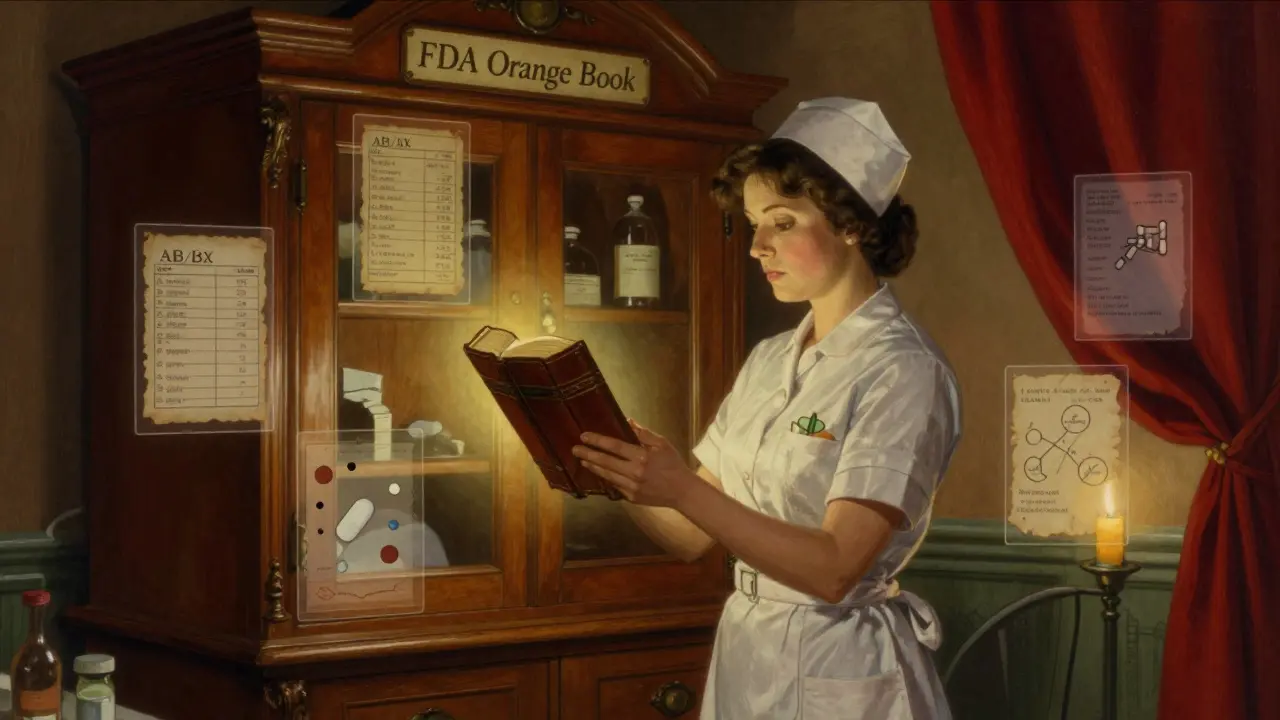
If you’re trying to figure out if one generic can safely replace another, the FDA Orange Book is the official government database of approved generic drugs and their therapeutic equivalence ratings. As of November 2023, it lists over 20,000 generic products across nearly 15,000 brand-name drugs.
Each entry has a rating: "AB" means it’s interchangeable. "BX" means it’s not. "AP" means it’s approved but not yet rated. These ratings aren’t just for doctors - they’re used by insurers, pharmacies, and state laws to decide what gets substituted at the counter.
Here’s the problem: the Orange Book doesn’t explain ratings in plain language. It’s a spreadsheet-like database. You need to know how to read it. That’s why most people use it through DailyMed or Drugs.com, which pull the data and make it easier to understand. But if you’re digging into substitution policies or legal requirements - the Orange Book is where the truth lives.
How Professionals Use These Resources Together
Most healthcare workers don’t rely on just one source. They use a mix.
A pharmacist at a community pharmacy might start with MedlinePlus to explain the drug to a patient, then check DailyMed to confirm the exact label, and finally use Drugs.com to run an interaction check before dispensing. A hospital pharmacist might pull DailyMed for compliance, Lexicomp (a paid tool) for complex cases, and the Orange Book to verify substitution rules.
According to a 2023 survey by the American Pharmacists Association, 89% of pharmacists use DailyMed daily. 76% use Lexicomp. 68% use MedlinePlus. 57% use Drugs.com. The pattern is clear: free tools handle the basics. Paid tools handle the complexity. But if you can’t afford a subscription, the free ones - used together - still give you 90% of what you need.
What’s Missing? And What’s Coming
Even the best free resources have gaps. DailyMed updates in 72 hours - but what if a safety alert drops at 3 a.m.? Lexicomp updates hourly. MedlinePlus doesn’t cover every rare generic. Drugs.com doesn’t tell you about off-label uses.
But things are changing. In 2023, DailyMed launched an API so EHR systems can pull its data automatically. The FDA is updating the Orange Book to include real-world data, not just lab studies. MedlinePlus is adding 15 new languages by late 2024. And the NIH just got $15 million to improve patient-facing tools.
For now, the best advice is simple: start with MedlinePlus if you’re a patient. Use DailyMed if you need legal or clinical accuracy. Check Drugs.com for quick safety checks. And always cross-reference when something feels off.
Quick Checklist: Where to Go for What
- Need simple, clear explanations? → Go to MedlinePlus
- Need the official FDA label? → Go to DailyMed
- Need to check drug interactions? → Go to Drugs.com
- Need to know if a generic can be swapped? → Check the FDA Orange Book
- Need to identify a pill? → Use the Drugs.com Pill Identifier
Are all generic drugs exactly the same as brand-name drugs?
No. While generics must contain the same active ingredient and meet FDA standards for strength and absorption, small differences in inactive ingredients or manufacturing can affect how the drug works in some people. For drugs with a narrow therapeutic index - like levothyroxine, warfarin, or cyclosporine - even tiny variations matter. That’s why the FDA assigns therapeutic equivalence ratings. Always check the Orange Book or ask your pharmacist before switching.
Can I trust Drugs.com if it’s not a government site?
Yes - but understand its limits. Drugs.com pulls data from FDA labels, AHFS DI, and Micromedex - all reputable sources. Its interaction checker is one of the most accurate free tools available. However, it’s not a substitute for professional medical advice. It doesn’t cover every off-label use or rare side effect. Use it as a fast reference, not a final authority. Always confirm critical decisions with a pharmacist or doctor.
Why doesn’t MedlinePlus have all the dosing details I need?
MedlinePlus is designed for patient education, not clinical decision-making. It avoids complex math, weight-based dosing, or renal adjustments because most patients don’t need that level of detail. If you need precise dosing - especially for children, elderly patients, or those with kidney disease - use DailyMed or consult a pharmacist. MedlinePlus tells you "take once daily." DailyMed tells you "take 10 mg PO daily, adjust based on serum levels."
Is DailyMed really the most reliable source?
Yes - for regulatory accuracy. DailyMed is the only source that provides the exact, legally binding FDA-approved labeling submitted by manufacturers. It’s used by hospitals, pharmacies, and regulators as the gold standard. No other free site has 100% compliance with FDA requirements. If you’re verifying a substitution, defending a clinical decision, or checking for legal compliance - DailyMed is your only reliable source.
What should I do if I can’t find my generic drug on any of these sites?
If a drug doesn’t appear on MedlinePlus, DailyMed, or Drugs.com, it may be very new, very obscure, or not yet approved in the U.S. First, check the FDA’s Orange Book - some drugs are listed there before appearing elsewhere. If it’s still missing, contact your pharmacist or prescribing doctor. They have access to professional databases like Lexicomp or Micromedex that include drugs not yet public. Never assume a drug is safe just because you can’t find info - always ask a professional.
Generic drugs are a cornerstone of modern healthcare. They save billions each year and make treatment accessible. But their value depends entirely on accurate information. Don’t rely on random websites, social media, or guesswork. Use the tools that are built for this job - and use them the right way. Your health depends on it.



Comments(11)